
How to Stop Freaking Out
A short lesson in Stoicism.

Recently, my life has been in a bit of a spiral.
Not a downward spiral, thankfully, but just a little chaotic spiral. Day-to-day life feels like a freaking tornado.
For the last few months, I’ve been:
Cutting weight for my next competition
Helping plan (and paying for) my wedding
Training as hard as I can
Running my online business (and trying to build a better one)
Traveling constantly for seminars and training
Getting ready to move to California in late May/early June of this year
I’ve been a wee bit stressed. A younger version of myself would have struggled to manage just one of the things that I’m doing now.
And while I’m certainly not free of “stress”, I do feel like I’ve hit my stride in terms of managing it, performing despite it, and remembering what matters at the end of the day, when all of these “things” are done.
Today, we’re talking about anxiety, stoicism, and how to get over yourself.
A lesson from the Stoics.
Stoicism maybe isn’t my favorite philosophy, but it’s one of the most practical philosophies for life today.
We have distraction and chaos at our fingertips. Every time you pull up the news, the world’s ending. Every time you open your phone, there’s a new trend you need to obsess over or a new product you need to buy. Even in Jiu-Jitsu, there’s always a new training method, technique, or athlete people are following.
It was cool when the trendy thing was the Woj Lock, but it was a little bit distracting.
Since I began reading Thoreau’s Walden, I’ve been trying to work on following the trendy stuff less and focusing on what seems to really matter to me.
Deep work. Deep leisure. Quality time with loved ones. Flow states. Good food. Adventures. Books. Movies. Building a better life for myself and my loved ones.
And look, maybe I’m not as good a global citizen these days because I don’t really watch current events much, but the effects this has on my peace make it worth it.
It’s like Marcus Aurelius says in Meditations:
“The happiness of your life depends upon the quality of your thoughts.”
I believe this to be true, which means that it’s very important that I pay attention to what impacts the quality of my thoughts. Too much outside noise, in my experience, increases anxiety and distracts me from the most important things in my life.
This is not good. In my experience, it’s not good to not be in control of your mind.
Focus on gratitude.
Gratitude and stress do not coexist well.
The more grateful you are, the easier the burden of the stress that you feel will become.
This is something that helps me through a lot of things, but for some examples, let’s talk about how gratitude is helping me with weight cutting and wedding planning, specifically. These are 2 seemingly unrelated things that both require the same focus.
Is planning a wedding stressful? Yes. Is trying to lose 20 pounds in 6 weeks stressful? You’re damn right.
But when I remember why I’m doing all of these things, the stress is eased. When I remember that in 3 weeks from now I’ll be done competing and wishing I was back in the arena, I am more grateful for the opportunity to cut weight. When I remember that I’m only ever going to get married once in my life, making time to talk to the coordinator, try on tuxes, or pay the catering bill isn’t a chore anymore; it’s an investment in a once-in-a-lifetime experience.
Gratitude is a key tool that you can use to improve the quality of your thoughts.
Here’s another quote from Meditations that I like:
“You have power over your mind - not outside events. Realize this, and you will find strength.”
You can only impact your outcomes and the outside of your events so much, but sometimes, they’re like the weather.
Sometimes, your stress is hitting you so hard because you’re forcing yourself to sit in the rain instead of just opening an umbrella.
Where philosophy ends.
Reading philosophy, in my experience, helps me more with the internal experience than the physical one. It helps me think better to study philosophy. It helps give me clarity and direction on what I ought to be doing with my life and with my time.
But without action, philosophy is kind of useless.
Action is the key to actually getting past your anxiety. Action is the key to a better quality of life.
And by this, I don’t necessarily mean working out or practicing Jiu-Jitsu, although those are great things to do for your mental health.
Let me put it in the lens of my current situation:
The more I worry about my weight cut, the worse it gets. But if I just eat well and go to the gym and get in the sauna a few times per week for heat acclimation, the weight cut is really nothing more than a minor inconvenience. The same as a traffic jam or a flight delay. This means that the key to getting over the stress of my weight cut is to shut up, eat right, and do what I’m supposed to do. Simple, huh?
If I sit at home and count my dollars and freak out about our wedding, the wedding would become a super painful experience. But by simply reminding myself that this is going to be my only wedding of literally my entire life, all of the stress just becomes a minor inconvenience. Basically, just plan the damn thing as best you can, pay the bill, and enjoy it.
I won’t bore you by going deeper, but I’ve done this thought exercise with everything on my list of stresses.
Writing it out helps.
Closing Thoughts
I get a lot of messages from people who ask me for advice about dealing with anxiety in Jiu-Jitsu.
People struggle with anxiety about competing. Others struggle with anxiety about getting their next belt. Hell, a lot of people even just struggle with anxiety about going to training.
Anxiety is a common and very normal struggle. It’s a human problem. I think one big problem with our current culture is that we often think of anxiety and stress as signs of weakness, not human problems that are meant to be dealt with.
This is flawed because, in my experience, everyone is stressed and everyone is freaking out. I know only a handful of people who are genuinely calm and living calm lives.
Everyone else is just trying to sort themselves out in a storm of craziness.
And in that storm of craziness, I try to simplify everything:
Pay attention to the quality of your thoughts
Focus on gratitude
Act in the highest virtue you can
One step at a time, one foot in front of the other.
Gain a little momentum, and people will start to think your anxiety was never there.
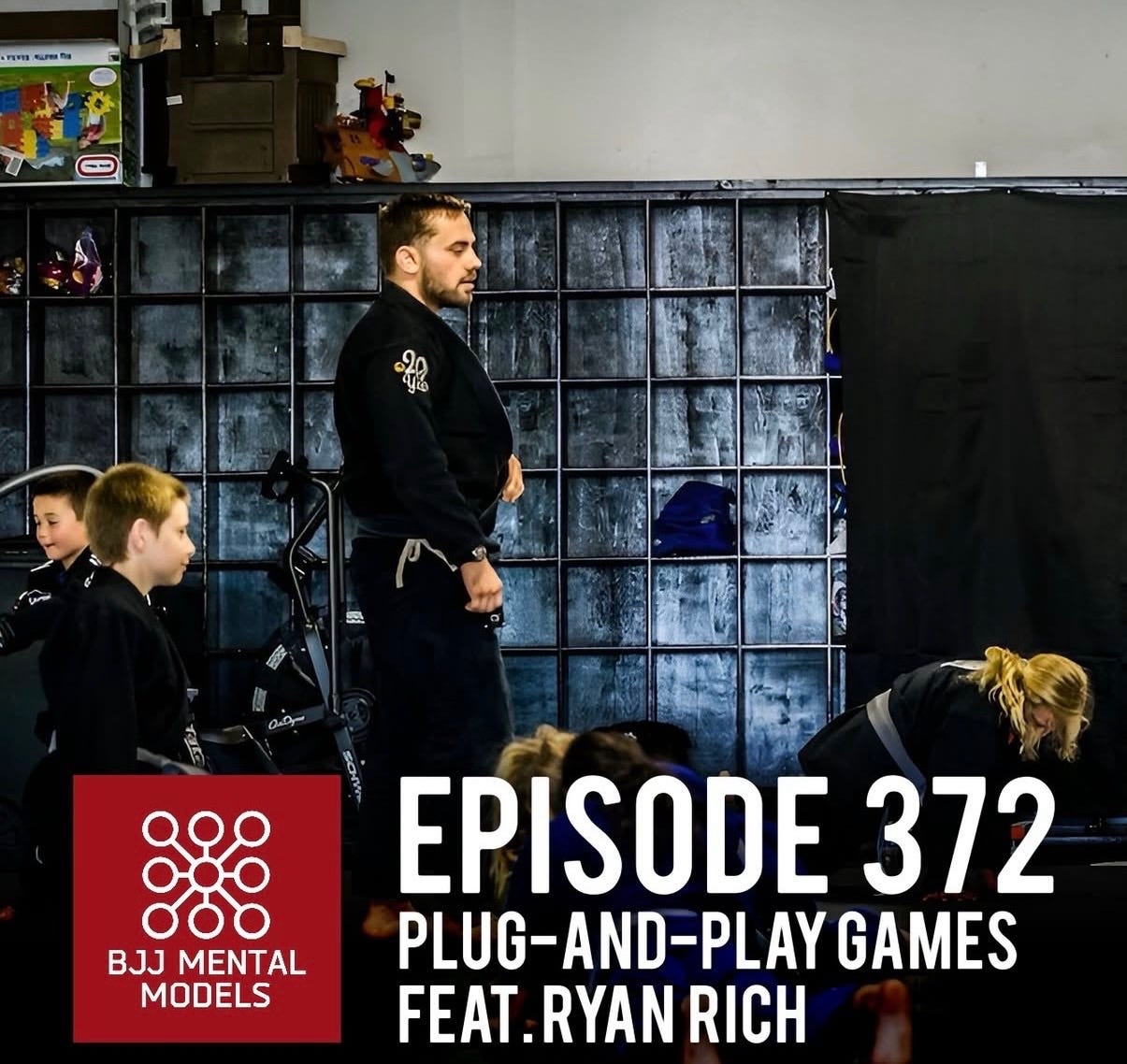
The Grappler’s Diary is sponsored by BJJ Mental Models, the world’s #1 Jiu-Jitsu education podcast!
This week, Steve Kwan sits down with Ryan Rich to explore game-based learning in Jiu-Jitsu: what it actually looks like in a real gym, why “plug-and-play” games aren’t as simple as they sound, and how coaches can balance skill development with student retention. Ryan shares hard-earned lessons from running a modern academy and explains how games can reduce frustration while accelerating learning. His top 5 takeaways:
🎮 Games aren’t magic: Pre-made games can work, but only if you adapt them to the room and iterate based on student response.
🧠 Reduce early frustration: Games give beginners meaningful reps sooner, closing the gap between learning a concept and applying it live.
🏗️ Teach to the room: Body types, attention spans, and experience levels all shape how a game should be structured.
⚖️ Balance skill vs. business: Better learning methods still need to feel approachable, or students won’t stick around.
📚 Understand how people learn: A basic grasp of motor learning (before designing games) dramatically improves coaching outcomes.
Listen now by searching for BJJ Mental Models in your podcast app, or visit this link.
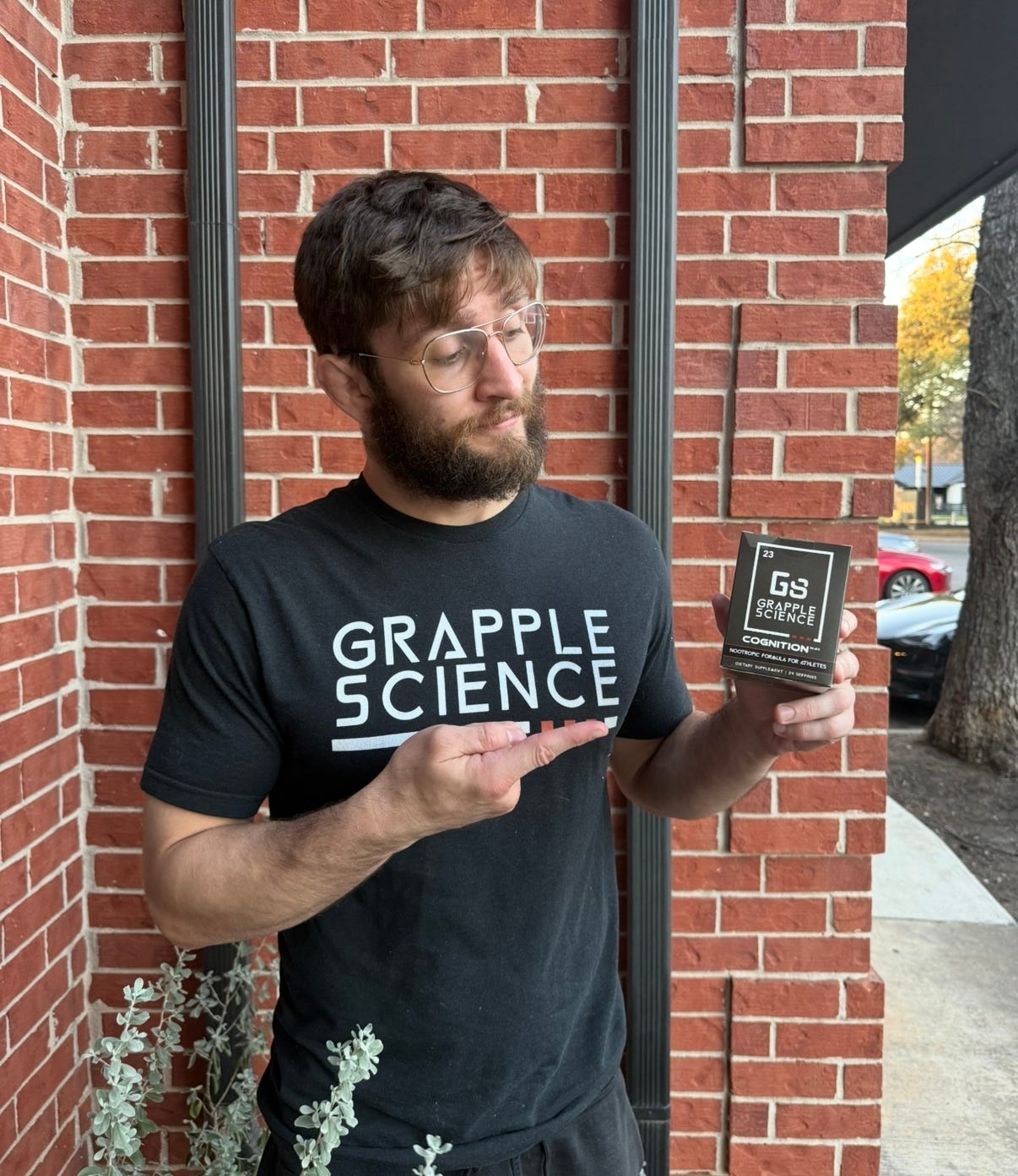
The Grappler’s Diary is also sponsored by GRAPPLE SCIENCE!
When I’m on the road training, teaching seminars, or competing, I only bring a handful of supplements with me.
Typically, I bring about a week’s worth of LMNT salts and a Grapple Science packet for every single training session/seminar. Grapple Science helps me stay focused, think clearly, and make decisions in a split second.
What is Grapple Science?
Grapple Science is the world’s first Jiu-Jitsu nootropic — designed by grapplers, for grapplers.
Grappling is a sport of both mental and physical problem-solving that demands rapid cognitive processing and split-second decision-making. Basically, Grapple Science (and their flagship product, Cognition) makes you less stupid on the mat. It helps you perform your best.
Think caffeine but with no jitters.
It’s one of my favorite products.
Hit this link to give them a try and use the code “DIARY” for a little discount when you do.
Also published this week:
Thank you for reading another edition of The Grappler’s Diary!
If you enjoyed reading this article, share it with friends! Or, click on the ❤️ button on this post so more people can discover it on Substack!